

When HR professionals speak up about potential legal violations, are they protected from retaliation?
Written by Tanner Michelle Scheef
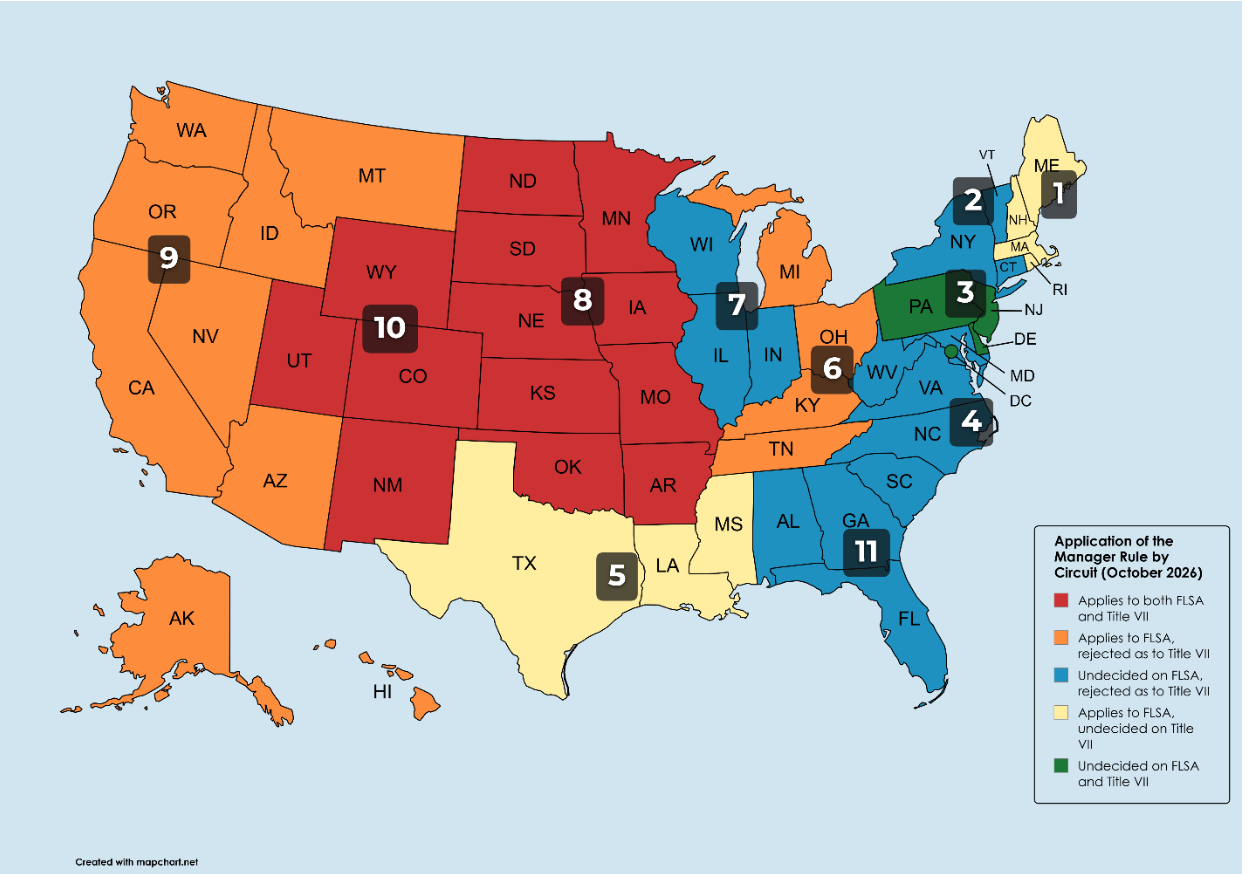
Are you a manager or HR professional who has been retaliated against for escalating concerns about legal violations against your staff? Here’s what you need to know:
The common sense answer would be that you are protected by the anti-retaliation provisions of the various employment laws, but (surprise, surprise) the law doesn’t always follow the rules of common sense. The real answer is a lawyer’s favorite phrase: “it depends.”
What protection you have depends not only on your role, but the statute the protected activity is under and what state you are in. While many statutes are written the same way, there is variation in the language of the anti-retaliation provisions. The confusion about what constitutes protected activity for someone in a managerial role has led to the doctrine known as the “Manager Rule.”
The Manager Rule originated as a doctrine of the Fair Labor Standards Act. The FLSA’s retaliation provision makes it unlawful for an employer:
“to discharge or in any other manner discriminate against any employee because such employee has filed any complaint or instituted or caused to be instituted any proceeding under or related to this chapter, or has testified or is about to testify in any such proceeding, or has served or is about to serve on an industry committee.” 29 U.S.C. § 215(a)(3) (emphasis added).
Because the FLSA’s use of the phrase “filed any complaint” distinguishes it from Title VII’s use of the broader “opposed any practice,” the Manager Rule came to be. The rule holds that a management employee (Supervisor, Manager, HR, etc.) who raises or opposes a compliance issue as part of their normal job duties hasn’t engaged in activity protected from retaliation by the statute (“protected activity”). Instead, for the behavior to count as protected activity under the FLSA, the management employee has to “step outside” their role to trigger anti-retaliation protection. In short, if reporting this kind of issue is part of your duties, it would not count as protected activity such that you are protected under the FLSA’s retaliation provision.
There is a circuit split as to the application of the Manager Rule in the FLSA context.
- The First, Fifth, Sixth, Eighth, and Tenth Circuits all apply the Manager Rule test in an FLSA context. Claudio-Gotay v. Becton Dickinson Caribe, Ltd., 375 F.3d 99, 102 (1st Cir. 2004); Hagan v. EchoStar Satellite, L.L.C., 529 F.3d 617 (5th Cir. 2008); McKinnon v. L-3 Commc'ns Corp., 814 F. App'x 35, 43 (6th Cir. 2020) (unpub.) (confirmed as “the FLSA manager rule” in Jackson v. Genesee Cnty. Road Comm'n, 999 F.3d 333 (6th Cir. 2021)); EEOC v. HBE Corp., 135 F.3d 543 (8th Cir. 1998); McKenzie v. Renberg's, Inc., 94 F.3d 1478, 1486–87 (10th Cir. 1996).
- The Ninth Circuit applied a “fair notice” test instead, calling it “likely consistent” with the manager rule, but declining to decide if the tests differed functionally. Rosenfield v. GlobalTranz Enterprises, Inc., 811 F.3d 282, 287–88 (9th Cir. 2015).
- The Second, Third, Fourth, Seventh, Eleventh, and D.C. Circuit have all yet to rule on whether it applies, though none have outright precluded its application in a FLSA context. Littlejohn v. City of N.Y., 795 F.3d 297, 317 n.16 (2d Cir. 2015); Uronis v. Cabot Oil & Gas Corp., 49 F.4th 263 (3d Cir. 2022); DeMasters v. Carilion Clinic, 796 F.3d 409, 421–22 (4th Cir. 2015); Owens v. Old Wisconsin Sausage Co., Inc., 870 F.3d 662 (7th Cir. 2017); Patterson v. Georgia Pacific, LLC, 38 F.4th 1336 (11th Cir. 2022); United States ex rel. Lott v. Not-For-Profit Hosp. Corp., 296 F. Supp. 3d 143 (D.D.C. 2017).
So, when is a management employee protected under the FLSA?
An employee “steps outside” the representative role and engages in protected activity when they:
- File (or threatens to file) an action adverse to the employer—e.g., their own FLSA complaint or lawsuit (not on someone else’s behalf);
- Actively assist other employees in asserting their FLSA rights—not just processing their complaints as part of their own job, but actively advocating on their behalf; or
- Otherwise engage in activity that could reasonably be perceived as directed toward the assertion of rights protected by the statute.
The key distinction is adversity to the employer, not just awareness or advocacy-as-job-duty. Merely evaluating the situation or running the issue up the flagpole isn’t going to cut it. The management employee must take a position adverse to the employer. There is, however, no bright line test. The court must look at the actual role and the actions taken. Management, HR, and in-house counsel are often expected to act as intermediaries carrying things up the ladder, thus something more than their average duties must be done. Compare: “this could be an issue” vs. “I think this is illegal and I refuse to go along with it.”
What about anti-discrimination statutes like Title VII? As stated earlier, the anti-retaliation provision of Title VII is broader than that of the FLSA. Title VII’s opposition clause protects “any” employee who “has opposed any practice made an unlawful employment practice.” 42 U.S.C. § 2000e-3(a). The ADA and ADEA have the same language in their anti-retaliation provisions. (ADA: 42 U.S.C. § 12203(a): “No person shall discriminate against any individual because such individual has opposed any act or practice made unlawful”; ADEA: 29 U.S.C. § 623(d): unlawful for an employer to discriminate against an employee “because such individual has opposed any practice made unlawful by this section”).
The Supreme Court has made clear that Title VII’s provisions should be considered broadly, given its purposefully broad language. See eg. Crawford v. Metropolitan Government of Nashville and Davidson County, Tennessee, 555 U.S. 271, 276 (2009); Robinson v. Shell Oil Co., 519 U.S. 337, 346 (1997). For that reason, a rule requiring managers to act outside of their normal duties in a Title VII case would be contrary to the Court’s rationale in Crawford, where the Court defined “oppose” as “to be hostile or adverse to.” The ordinary meaning of the word “oppose” is not limited to activity outside an employee’s normal job duties. The Supreme Court in Crawford, explained that a person can “oppose” something by responding to someone’s question just as surely as by provoking the discussion in the first place. Crawford, 555 U.S. at 277-78.
The only Circuits to apply the Manager Rule to Title VII are the 8th and 10th Circuits, though the 10th Circuit’s decision is unpublished. EEOC v. HBE Corp., 135 F.3d 543, 554 (8th Cir. 1998); Weeks v. Kansas, 503 F. App'x 640, 642 (10th Cir. 2012) (unpublished). While the First has expressed concerns, it has not formally rejected the application of the Manager Rule to Title VII. Collazo v. Bristol-Myers Squibb Mfg., Inc., 617 F.3d 39 (1st Cir. 2010).
While the Fifth, Third, and D.C. Circuits have yet to comment on the matter, the Second, Fourth, Sixth, Seventh, Ninth, and Eleventh have all expressly rejected the Manager Rule in Title VII cases. See Littlejohn v. City of New York, 795 F.3d 297 (2d Cir. 2015); DeMasters v. Carilion Clinic, 796 F.3d 409 (4th Cir. 2015); Johnson v. University of Cincinatti, 215 F.3d 561, 580-81 (6th Cir. 2000); Pratt v. Wisconsin Aluminum Foundry, 183 F.4th 541 (7th Cir. 2026); Rosenfield v. GlobalTranz Enterprises, Inc., 811 F.3d 282 (9th Cir. 2015); Patterson v. Georgia Pacific, LLC, No. 20-12733 (11th Cir. 2022). Several district courts within the Fifth Circuit have already refused to apply the Manager Rule to Title VII claims until there is direct guidance from the Fifth Circuit. Donald v. Plus4 Credit Union, No. CV H-16-123, 2017 WL 3235659 (S.D. Tex. July 31, 2017); Binh Hoa Le v. Exeter Fin. Corp., No. 3:15-CV-3839-L, 2019 WL 1436375 (N.D. Tex. Mar. 31, 2019), aff'd, 990 F.3d 410 (5th Cir. 2021), and aff'd, 990 F.3d 410 (5th Cir. 2021); Rangel v. Omni Hotel Mgmt. Corp, No. SA-09-CV-0811, 2010 WL 3927744, at *5 (W.D. Tex. Oct. 4, 2010) and Durham v. Oil States Energy Servs., No. MO:19-CV-00215-DC, 2021 U.S. Dist. LEXIS 125772, at *23 (W.D. Tex. Jan. 21, 2021).
What about the FMLA? While no courts have opined on the application of the Manager Rule to the FMLA, the FMLA’s anti-retaliation provision only protects an employee’s own exercise of substantive rights (taking leave), not just “opposition” to someone else’s violation. Thus, it more closely tracks with the FLSA’s language rather than Title VII’s. 29 U.S.C. § 2615(a)(2) (2018); 29 U.S.C. § 2615(b) (2018) OR 29 C.F.R. § 825.220 (2024); 29 C.F.R. § 825.220(a)(3)(i) (2024).
So, practically, what should a management employee take into consideration to protect themselves?
- Framing: Not “I want to flag a compliance risk” but “I believe this violates the law, and I’m asserting that on my own behalf/someone else’s behalf”
- Advocate: Help the coworker draft their complaint or advocate for them internally in a way that is meaningfully different than the normal duties of your job. In short, go above and beyond.
- Refuse: If you believe something happening is unlawful, refuse to participate in the unlawful act and document your refusal.
- Document everything: Keeping a record not only supports your case, but it also helps establish that the company is on notice.
- Filing: Consider filing externally with the EEOC or DOL Wage and Hour division, this is the clearest example of someone stepping outside of their role.
If you feel as though you may be facing retaliation, reach out to an attorney to discuss your rights.
This article is provided for general informational purposes only and does not constitute legal advice or create an attorney-client relationship. Employment laws can vary depending on the circumstances.
This is paragraph text. Click it or hit the Manage Text button to change the font, color, size, format, and more. To set up site-wide paragraph and title styles, go to Site Theme.
This is paragraph text. Click it or hit the Manage Text button to change the font, color, size, format, and more. To set up site-wide paragraph and title styles, go to Site Theme.